A Resource We Take for Granted
Turn on a tap. Fill a glass.
Drink.
For most of us, this sequence
takes less than ten seconds and requires no thought at all. But for millions of
people around the world, clean water is not a given — it's a daily struggle
that shapes everything else in their lives: how far a child walks before
school, how often a family falls ill, how much time a woman has left over for
work or education after fetching water from a distant, often unsafe source.
At Emyris Foundation, we have
come to see clean water not as a single issue, but as the foundation beneath
dozens of others. You cannot talk about health, education, or economic
opportunity in a community without first talking about water. This is why Clean
Water Initiatives are emerging as one of the most important frontiers in our
foundation's future work.
Why We Are Turning Our Attention to Water
Every foundation must choose
where to direct its energy, and that choice should never be arbitrary. As we
look ahead at the communities we hope to serve, one truth keeps surfacing: so
much of what we care about — health, education, dignity, opportunity — depends
on something as basic as access to safe water.
We have watched, studied, and
listened. And what we have learned has convinced us that water scarcity is not
a peripheral issue. It is often the root cause standing behind the very
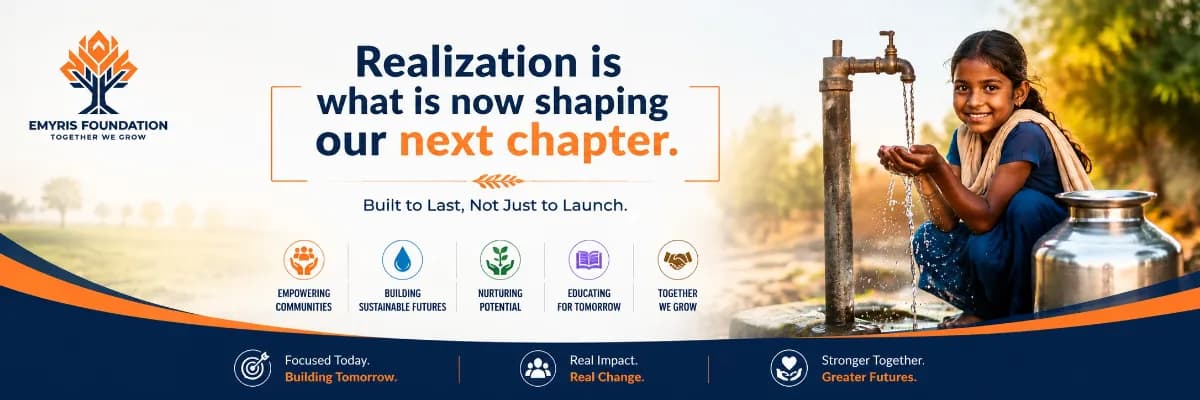
problems we already work to solve. That realization is what is now shaping our
next chapter.
When water is unsafe or hard to
access, the effects ripple outward in ways that are easy to overlook:
Health suffers first. Waterborne
diseases like diarrhea, cholera, and typhoid remain leading causes of illness
and death in communities without safe water access, disproportionately
affecting children under five.
Education stalls. In many
households, it's children — especially girls — who are sent to collect water,
often walking long distances multiple times a day. Every hour spent carrying
water is an hour not spent in a classroom.
Economic potential is capped. Time
and energy spent securing water is time not spent farming, working, or building
a livelihood. Illness caused by contaminated water leads to missed workdays and
mounting medical costs.
Dignity is compromised. Access
to clean water and sanitation is tied directly to basic human dignity —
something no community should have to negotiate for.
This is why we believe that when
we eventually step into this space, we won't just be solving one problem. We
will be removing a barrier that touches nearly every other area of a person's
life.
Our Commitment: Built to Last, Not Just to Launch
We have seen enough well-meaning
water projects elsewhere fail within a few years — pumps that break down with
no one trained to fix them, wells that run dry because local hydrology was
never properly assessed, systems built without any real input from the people
meant to use them. We do not want to repeat those mistakes.
As we prepare to take up this work,
we are committing ourselves to a different standard from day one. When Emyris
Foundation launches its clean water initiatives, they will be designed around
three non-negotiable principles:
1. Community Ownership
We will not arrive with a fixed
blueprint. Before any construction begins, we intend to work directly with
local communities to understand their specific needs, existing infrastructure,
and the realities of daily life. Communities will be involved in planning,
decision-making, and — critically — in the long-term maintenance of any systems
we help build. We believe a well that belongs to the community, both
practically and emotionally, is a well that gets taken care of.
2. Technical Sustainability
Clean water cannot simply mean
installing a pump or drilling a borehole. It has to mean making sure that
system continues to function five, ten, twenty years down the line. That will
require proper geological assessment, appropriate technology suited to local
conditions, and training local technicians who can maintain and repair systems
without waiting for outside help.
3. Education Alongside
Infrastructure
We know that access to clean
water only translates into better health outcomes when it's paired with hygiene
education. Any future initiative we launch will integrate awareness programs on
sanitation, handwashing, and safe water storage from the very beginning, so the
benefits of clean water are fully realized rather than partially lost to old
habits or misinformation.
What We Hope Change Will Look Like
It's one thing to speak of clean
water in the abstract. It's another to imagine what it could actually mean for
a family once it becomes part of daily life.
We picture a mother no longer
forced to choose between fetching water and caring for a sick child — because
fewer children fall ill in the first place. We picture a girl who once spent
two hours a day walking to a distant source, finally free to spend that time in
a classroom instead. We picture a small farmer gaining reliable access to water
for his family and his crops, strengthening food security for the whole
household. We picture a local health worker seeing fewer preventable illnesses
walk through the clinic door.
These are not achievements we can
claim yet. But they are the outcomes that drive us to prepare seriously for
this work, rather than approach it lightly.
We Are Honest About the Road Ahead
We do not underestimate the scale
of this challenge. Water scarcity and unsafe water access remain widespread,
and the solutions required — infrastructure, maintenance systems, education,
and sustained community engagement — demand time, resources, and patience to
get right.
We are also mindful that climate
change is making this work more urgent by the year. Shifting rainfall patterns,
prolonged droughts, and depleted groundwater sources mean that any clean water
initiative we launch must be designed with tomorrow's conditions in mind, not
just today's.
This is why, even before our
first project begins, we are investing time in research, learning from
organizations already doing this work well, and building the internal expertise
we'll need to do it responsibly rather than rush in unprepared.
Our Vision for the Future
Our vision is simple to state and
demanding to achieve: a future where no family has to choose between clean
water and anything else — not their child's education, not their health, not
their livelihood.
As Emyris Foundation grows, we
are determined to bring this same rigor and care to clean water that we bring
to every area of our work. We are not there yet — but we are actively laying
the groundwork: identifying communities most in need, forming partnerships with
technical experts, and shaping a model we believe can create lasting, not
temporary, change.
Water connects to everything. When
we finally step into this space, we don't just want to solve a single problem —
we want to open the door to healthier children, more time in classrooms,
stronger local economies, and communities with the foundation they need to
build their own future.
Join Us as We Prepare
Every initiative starts long
before the first well is dug or the first pipe is laid. It starts with a
foundation's willingness to look honestly at a problem, commit to doing it
right, and take the time needed to prepare properly.
That is where we stand today. We
invite our supporters, partners, and community to walk this early journey with
us — because the determination we bring now is what will shape the impact we're
able to create later.
If you believe, as we do, that
clean water is not a privilege but a right, we invite you to stay close to this
work as it takes shape. Together, we intend to turn this vision into reality —
one well, one community, one family at a time.